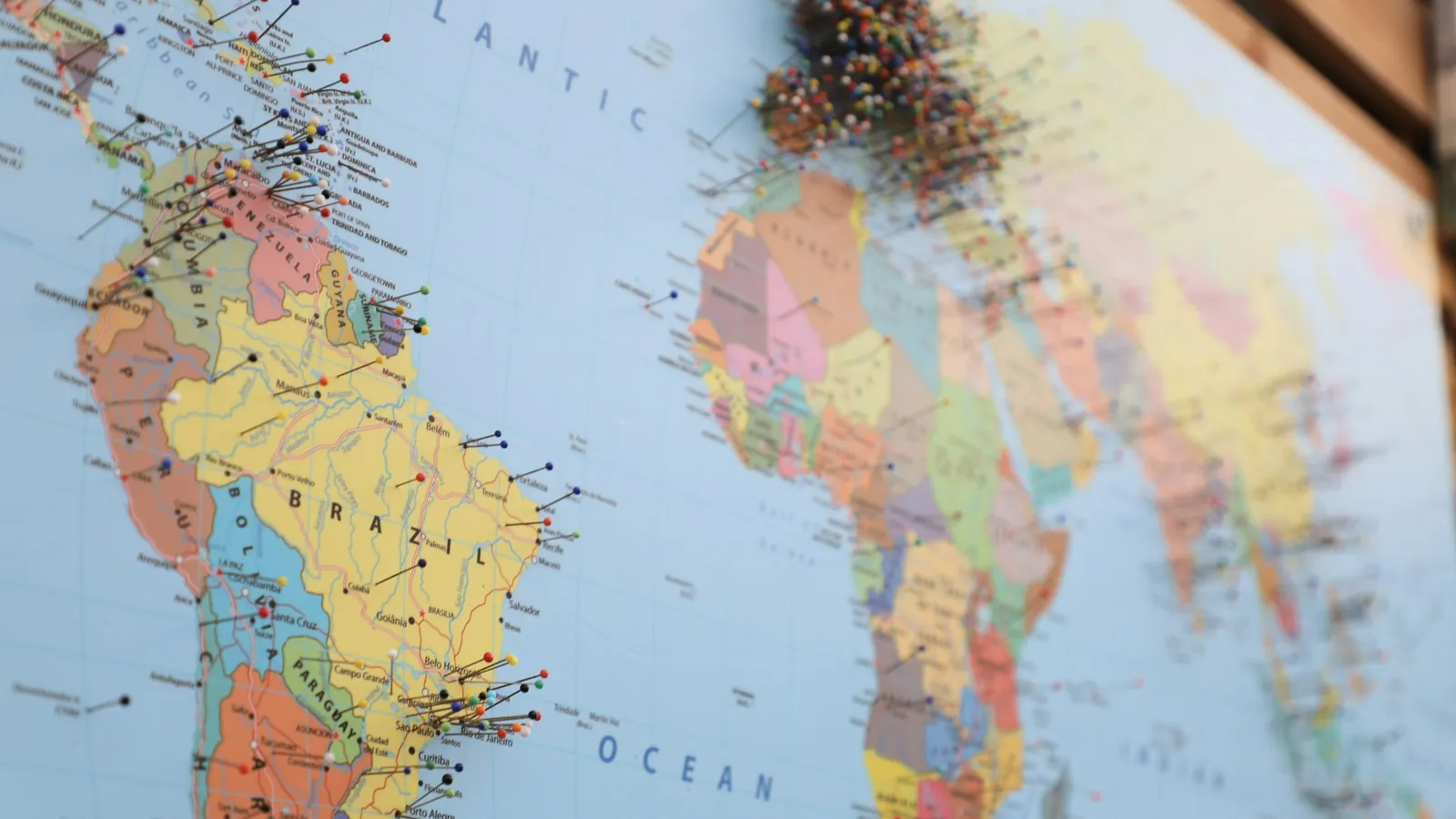
What separates a health and wellness brand from its category is often geography, in a way no map of consumers shows. Demand is spread across markets by population and spending power. The professionals who shape that demand are concentrated wherever practitioners live and work. Those two maps rarely line up. A client in one market is advised by a coach in another, and in some markets there is no local coach doing the advising at all. That distance is the geographic demand gap.
One thing to settle first. This is an explainer, not a data report. The numbers behind the gap are already published, in the report on the global and cross-border coaching footprint and in the one on the professional-workforce behaviour signal. This page does not re-run them, re-headline them or add a figure of its own. It explains the shape of the gap, why a single-sided tracker cannot see it, and which part of it stays behind the paywall.
The short answer
The geographic demand gap is the distance between where a category's demand sits and where the professionals who shape it are based. Only a panel holding both sides can see it, because the gap is the join rather than either side. The footprint and workforce behaviour reports carry the numbers; the country-level detail stays gated.
What this is, in one paragraph
This is an explainer built on a read of a professional network, not a general-population poll. Every figure on the page is quoted from one of two already-published hale reports, the global and cross-border coaching footprint and the professional-workforce behaviour signal, both drawn from an internal research project across the hale ecosystem of more than 40,000 professionals and their clients, combining a voluntary practice-profile survey of 2,184 valid responses with platform activity across a 90-day window in 2026. Nothing here is re-derived or estimated. Everything is aggregated and anonymised. The full method sits at the foot of the page.
Why the two maps drift apart
Start with why a gap exists at all. A coach is a person with a practice, and practices are built where practitioners live. Demand is thinner and more widely spread, because it follows populations and it moves when people move. For most of the history of personal training the two had to share a room, which kept them roughly aligned by force.
Digital coaching broke that link. A professional can now train a client on another continent, write a programme for someone they will never meet in person, and answer the product question that follows. The recommendation still arrives. It simply travels further than the professional does. Once supply and demand can sit in different places, the distance between them becomes a fact worth measuring rather than a rounding error.
Two shapes of the same gap
The gap appears in two forms, and they call for different responses.
The first is a market where demand exists but no local professional serves it. Clients there are coached across a border, so the recommendation shaping their purchase comes from someone based in another market, under assumptions formed elsewhere about what is available and what is normal. Their shortlist is being built by a voice the brand may not have in its home-market tracking at all.
The second is a market where professionals are present but the category is under-served. Presence is not the same as attention. A workforce can be large in a country and still leave whole categories unmentioned, because the professionals there have their own repertoire and their own confidence about what is worth recommending. The first shape is a supply gap. The second is an attention gap, and it shows up by asking professionals what they actually recommend rather than by counting how many of them exist.
Both shapes are invisible to a tracker that samples one side of the network. That is the next problem.
One side of the panel sees half the picture
A consumer panel can map demand. A coach-only survey can map supply. Neither can produce the gap, because the gap is the join between them, and a join needs both tables. That is the structural reason this measurement is two-sided: the same instrument, the same measures, the professional as influencer on one side and the client as consumer on the other.
The discipline is set out in Both Sides of the Sale, and the case for why the professional side carries so much of the weight is in the recommendation layer research. The consequence for the gap is plain enough. When a brand asks where its category is being decided, part of the honest answer is somewhere the brand is not currently measuring.
What the gap is not
A short list of things this page is not claiming, because the boundary matters more than the headline.
It is not a market-size figure. Nothing here says how large any category is in any country, and no market-size number belongs on a hale page without a named, dated source. It is not a claim that coaching is scarce everywhere; most markets have a professional layer, and in many it is dense. It is not a country-by-country league table, because country-level crosstabs sit beneath the published topline and are held as part of hale's brand-tracking work. And it is not a second version of the footprint report, which owns that number and states it in full.
One limit deserves stating plainly, because it applies to every figure quoted above. The read comes from the hale ecosystem, which skews towards independent, digitally engaged practitioners on the QuickCoach and FitFocus platforms. It is a strong signal about the network measured and a directional one about the wider non-clinical workforce. Credibility in this kind of work does not survive pretending otherwise.
Why it matters for a brand
A brand that tracks only its home market is watching one corner of a network that crosses borders. If the professional shaping your category in a given market is based in another one, a home-market read will not see that influence at all, and its absence will look like low awareness rather than a blind spot in the measurement.
The gap also changes how a brand should read its own numbers market by market. Where the professional view is strong and the consumer view is thin, the divergence is a leading signal rather than a contradiction, and the shape of it is the subject of the awareness gap explainer. Where a market is served from outside, the local consumer numbers are partly an echo of a conversation held elsewhere. The measures that make those readings possible, and how they fit together, are in the guide to what brand tracking is and in the brand health metrics guide.
None of that needs a country-by-country table. It needs the professional side measured, in the markets that matter to the brand, continuously, next to the consumer side.
The part of the map that stays gated
hale publishes the shape and holds the detail. The footprint figures are free to cite, because a category is better understood when the layer that shapes it is visible. The country-level crosstabs, the per-market recommend rates and the brand-level views beneath them are the paid product, and they stay there.
The line is deliberate rather than arbitrary. A published topline tells a brand which question to ask. The answer is specific to the brand, its category and its competitive set, and it moves month to month. One report, one number, published as a topline, is the honest version. A country table on a public page would be a different business giving away a different product.
The figures this page sits on
For completeness, the published numbers this explainer reconciles against, each attributed to the report that owns it. None of them is re-derived here, and none is this page's finding.
The gap: 42
Countries where clients are coached with no local coach present. Published in the cross-border footprint report.
The reach: 152
Countries where those clients are reached, read from the client side of the same panel. Same report.
The supply: 110+
Countries with active coaches in the hale ecosystem, the professional side of the map. Same report.
The rhythm: 28.7%
Share of platform sessions landing between 8am and noon local time, with under 2% overnight. From the workforce behaviour report.
See where your category is being shaped
If the professionals who decide your category sit in markets your tracking does not cover, part of your brand is being chosen out of sight. hale measures perception among coaches and their clients, continuously, across the markets you care about.
Where these figures come from
How we got these numbers
Source. Two already-published hale reports: The Global and Cross-Border Coaching Footprint (August 2026) and The Professional-Workforce Behaviour Signal (August 2026). Both draw on an internal research project across the hale ecosystem, which serves more than 40,000 fitness and health professionals and their clients, combining a voluntary practice-profile survey (2,184 valid responses, fielded March to September 2026) with platform activity across a 90-day window in 2026.
Reconciliation. Every figure on this page is quoted from one of those two reports and attributed to it. Nothing is re-derived or estimated here, and this page publishes no headline number of its own. The footprint figures belong to the cross-border report; the session-share figures belong to the workforce behaviour report.
Scope. A read of a professional network, not a census of the entire non-clinical workforce. The ecosystem sample skews towards independent, digitally engaged practitioners, so read it as a directional baseline. Country-level crosstabs are held as part of hale's brand-tracking work rather than published. Figures are rounded.
Privacy. Everything is aggregated and anonymised. No individual coach, client or business is identifiable, and no personally identifiable information is included.
Frequently asked questions
What is the geographic demand gap in health and wellness?
It is the distance between where a category's demand sits and where the professionals who shape it are based. Because coaching no longer requires the coach and the client to be in the same place, a recommendation can shape a purchase in one market while being made in another, and some markets are served with no local professional present at all.
Why can't a single-sided tracker measure the geographic demand gap?
Because the gap is the join between two sides rather than either side on its own. A consumer panel can map where demand is, and a coach-only survey can map where the workforce is, but the distance between the two appears only when both are read on the same instrument with the same measures. hale's panel holds the professional as influencer and the client as consumer in one network.
Does hale publish country-level demand-gap data?
No. The topline footprint figures are published and free to cite. Country-level crosstabs, per-market recommend rates and the brand-level views beneath them are held as part of hale's brand-tracking work, available to research and commercial partners rather than published on the site.
Published October 2026. The figures on this page are quoted from two already-published hale reports, drawn from an internal research project across the hale ecosystem of 40,000+ professionals and their clients; nothing here is re-derived or estimated. hale is a health-tech holding company; its coaching platforms, QuickCoach and FitFocus, form the network behind this research. To see where your category is being shaped, start a conversation or reach us at research@halehealth.io.
How hale research works: the panel, the instruments and the privacy rules.