Hale Research 2026
A research-facing view of the non-clinical health workforce

Non-clinical health practitioners, including independent coaches, small practices, and practitioner-led services operating outside conventional care, are difficult to observe systematically across countries and practice settings.
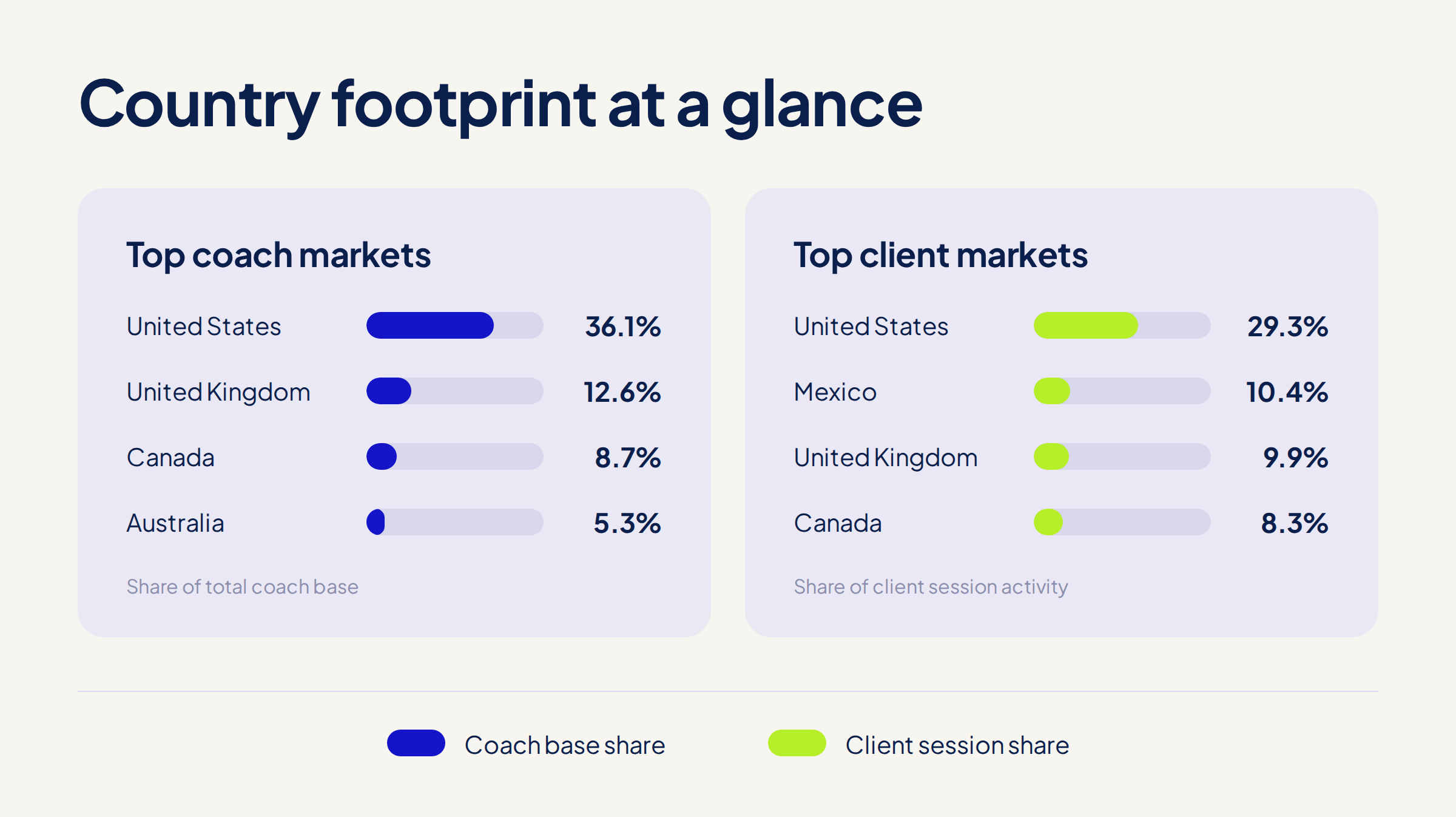
Hale's platform activity offers an empirical window into this population: anonymised, aggregate data on practitioner footprint, session geography, and practice structure across a large and geographically distributed ecosystem.

Key non-clinical health workforce insights

40,000+
Practitioners active in the Hale ecosystem
116
Countries with active coach operation
152
Countries with recorded client sessions
Workforce distribution signal
● 152 countries show client-session activity
● 116 countries have coach-operation coverage
● 36 countries have client demand but no local coach supply
Client sessions are recorded across 152 countries while active coach operation appears across 116. The 36-country gap is observable in the platform dataset and lends itself to several research angles: cross-validation against clinical workforce registries, mapping against population health indicators, or longitudinal analysis of how the gap moves with regulatory change.
Whether the gap reflects unmet need, distribution lag, or measurement artefact is the open question. Hale's role is to make the dataset legible and accessible; the research design sits with the partner institution.
What a research institution gains
Research access
Non-clinical practitioners are difficult to reach through conventional institutional channels. Hale offers a scoped entry point for exploratory work, pilot studies, or researcher-led deployment, without requiring the institution to build that access from scratch.
What Hale gains
Research credibility
Hale gains methodological credibility, institutional validation of dataset scope, and a pathway to publishing findings that are currently observable but not yet formally interpreted. The arrangement is a genuine exchange - not a sponsorship.
Potential research uses
Figures are drawn from anonymised, aggregate platform activity. The brief is intended as a starting point for academic conversation; any specific research use would require its own study design, data access agreement, and institutional review.
Workforce distribution and access
How does practitioner supply correlate with client demand across regions, and where do the patterns diverge from clinical workforce data?
Community-based delivery models
What does a workforce of independent practitioners operating across 100+ countries tell us about the scalability of non-clinical care?
Behaviour outside clinical settings
What do session cadence, timing, and retention reveal about engagement in populations clinical outcomes data does not reach?
Researcher-led recruitment pathways
Where institutional access to non-clinical practitioners is the barrier, can the platform serve as the recruitment, distribution, or deployment layer for research design?
Why this matters to us
“The non-clinical health workforce is large, global, and largely unmapped. Hale built this ecosystem to serve that workforce, and in doing so we have accumulated a window into it that, to our knowledge, does not exist elsewhere at this scale. We are not researchers. But we believe the data we hold has research value, and we are committed to making it available in ways that serve the broader public health system.” - Nicholas, CEO, Hale