Hale Partnership 2026
A practical route into non-clinical health research partnerships

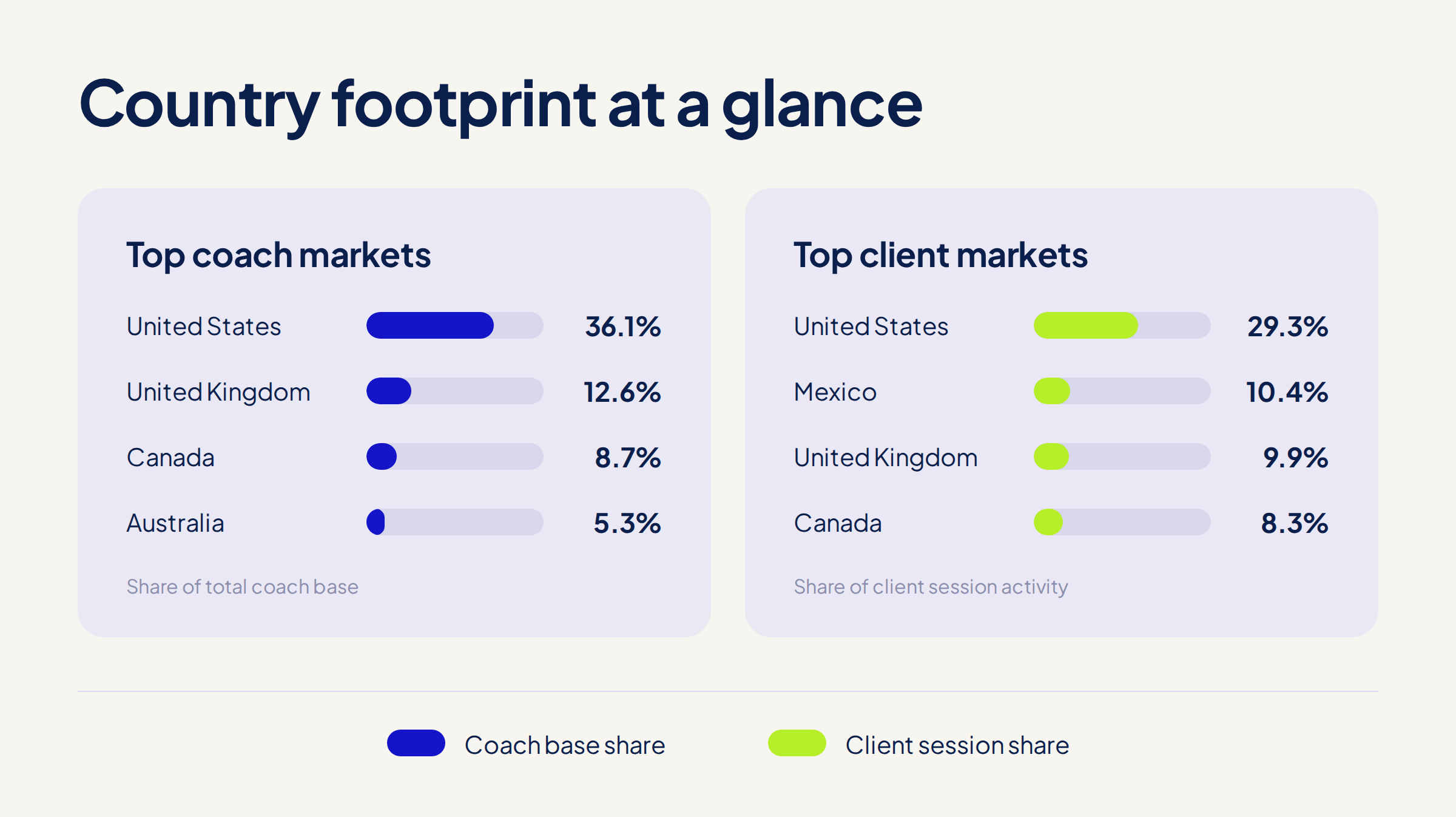
A large non-clinical health workforce operates outside conventional research access: independent coaches, small practices, practitioner-led services.
Hale runs the infrastructure this workforce uses every day. For partnership teams, that creates a practical entry point into a population institutional channels rarely reach at scale.

Key non-clinical health workforce insights

40,000+
Practitioners active in the Hale ecosystem

116
Countries with active coach operation
152
Countries with recorded client sessions
Illustrative signals from the current dataset
● 152 countries show client-session activity
● 116 countries have coach-operation coverage
● 36 countries have client demand but no local coach supply
Why client demand is appearing in 36 countries with no local coach supply is not something this brief can answer. It is the type of question a research partnership is built to investigate.
Converting a signal of this kind into research-grade evidence requires expertise Hale does not hold in-house: study design, comparison populations, cross-validation against clinical and administrative data. A partnership is how the signal becomes a finding.
What a research institution gains
Research access
Non-clinical practitioners are difficult to reach through conventional institutional channels. Hale offers a scoped entry point for exploratory work, pilot studies, or researcher-led deployment, without requiring the institution to build that access from scratch.
What Hale gains
Research credibility
Hale gains methodological credibility, institutional validation of dataset scope, and a pathway to publishing findings that are currently observable but not yet formally interpreted. The arrangement is a genuine exchange - not a sponsorship.
How a partnership conversation could be structured
A short sequence of scoped conversations can determine whether there is enough alignment to justify a more formal academic process.
1. Initial conversation
A short call with the academic lead or partnerships contact to establish mutual interest and identify the right people to bring in next.
3. Pilot scoping
A narrow first project with a clearly defined research question, agreed ownership, and a path to publication.
2. Data and methods alignment
A working review of dataset scope, methodological fit, and governance, run jointly so both sides understand what is on the table.
4. Formal approvals
The institution's standard pathway for ethics review, data agreements, and contracting.
Why this matters to us
“The non-clinical health workforce is large, global, and largely unmapped. Hale built this ecosystem to serve that workforce, and in doing so we have accumulated a window into it that, to our knowledge, does not exist elsewhere at this scale. We are not researchers. But we believe the data we hold has research value, and we are committed to making it available in ways that serve the broader public health system.” - Nicholas, CEO, Hale